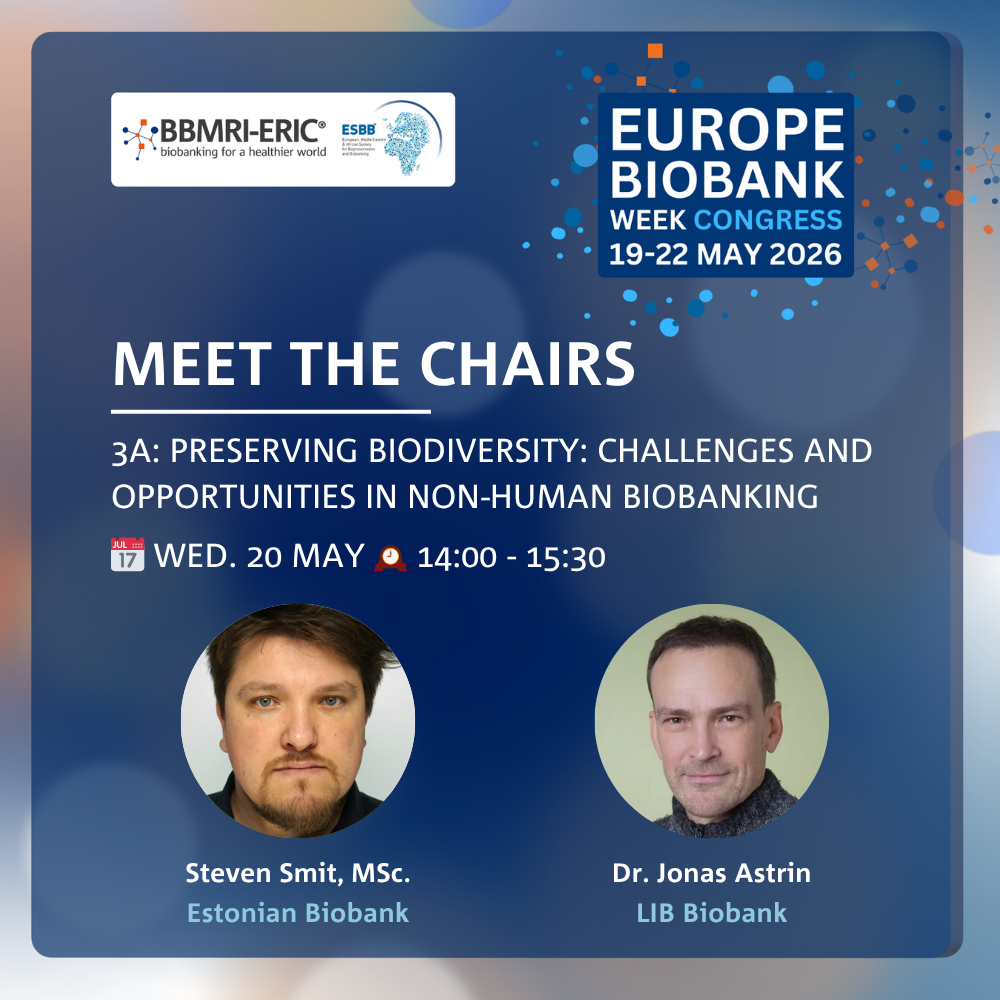
#EBW26 Previews: 3A – Preserving biodiversity: Challenges and opportunities in non-human biobanking
Non-human biobanks – encompassing amongst others animal, plant and microbial specimens – are essential for life science research and biodiversity conservation. They face challenges like ethical dilemmas, data standardisation and resource limitations not unlike human biobanks. Yet, they offer opportunities for basic research, ecological restoration, agricultural resilience and scientific innovation through advanced preservation, genomics and global collaboration. This session highlights their unique role in advancing integrated health for humans, animals and ecosystems.
Highlight speaker: Jonas Astrin – GGBN, the Global Genome Biodiversity Network and its new secretariat at LIB Biobank
Abstract: The Global Genome Biodiversity Network consists of over 120 biobanks at natural history collections, culture and environmental collections and zoological gardens, providing long-term storage and public access to materials used for molecular research and conservation applications. The GGBN Data Portal and Data Standard have been developed to enable standardised access to its member biobanks. GGBN fosters knowledge exchange and collaboration between biodiversity biobanks. The member-driven network is governed by a general assembly and an executive committee. Next to a technical management office, GGBN’s day-to-day operations are performed by its general secretariat, which has recently been relocated to LIB in Bonn.
Speakers included in this session:
- Barbora Rolečková and Michal Vinkler – From captive chickens to wild African mammals: Turning research collections into biobanks
- Bertrand Pain – OrganoZoo, CRB-Anim’s new platform dedicated to organoids for domestic animals
- Michele Grego – Marine cryopreservation across scales: from microbial communities to multicellular organisms
- Rosario Musumeci – MIRRI.IT – A national gateway to microbial biodiversity, scientific excellence and sustainable innovation
This session will be chaired by:
Dr. Jonas Astrin
Dr. Astrin is Section Head and Curator of the LIB Biobank at Leibniz Institute for the Analysis of Biodiversity Change, based at Museum Koenig, Bonn, Germany.
The LIB Biobank stores animal and environmental DNA, fixed tissue and viable cells, conducts methodological work and is very active in biodiversity biobanking networks.
Steven Smit, MSc.
Steven Smit has been the Head of the Biobank Lab at the Estonian Biobank since 2011 and has been involved in recruiting the majority of the 212,000 biobank participants as well as processing storage and the release of the respective samples as well as other activities.
Session details:
- Date: Wednesday 20 May
- Time: 14:00 – 15:30