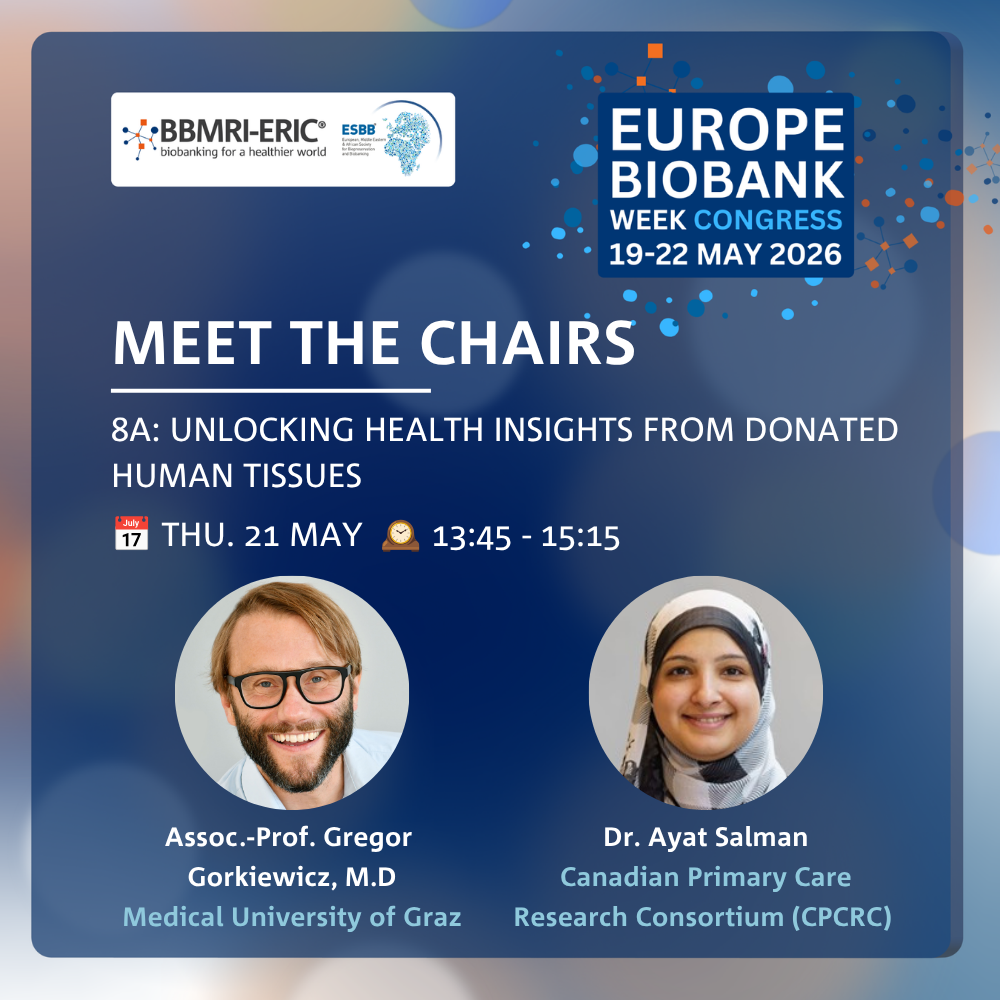
#EBW26 Previews: 8A: Unlocking health insights from donated human tissues
This session examines the ethical, technical and logistical challenges of collecting and managing human tissue donations, both post-mortem and from living donors. Experts will discuss consent, data integration and governance frameworks ensuring responsible use, sharing methodologies and case studies that demonstrate how tissue biobanks advance research and deepen understanding of health and disease.
Speakers included in this session:
- Michaela Th. Mayrhofer – Building Humangenom Austria: The Interplay of Ethical, Data, and Governance Dimensions
- Jörg Hamann – The Netherlands Brain Bank: An open-access platform for brain tissue and integrated health data
- Gregor Gorkiewicz – The “FMT in UC” microbe and host biorepository
- Cecilia Engels – Tissue biobanking: Interface requirements for high-quality support for biomedical research
- Beate Rinner – From pathology to precision oncology: Patient-derived tumour and normal tissue models as a translational interface
This session will be chaired by:
Assoc.-Prof. Gregor Gorkiewicz, M.D
Assoc.-Prof. Gorkiewicz is the vice chair of the Diagnostics and Research Institute of Pathology at Med Uni Graz and holds an associate professorship (tenured) for medical microbiome research. He also serves as the work group chair for infectious diseases pathology in the European Society of Pathology and is co-chair for the research field “Microbiome and Infection” at Med Uni Graz.
His main research interest is to understand the involvement of the microbiome in health promotion and disease development. As a pathologist he is specialised in gastro-intestinal-, pulmonary- and infectious disease pathology, as well as tumor genetics with a focus on molecular diagnostic methods. His research group studies the gut microbiome in the context of inflammatory GI diseases, specifically addressing its immunomodulatory potential and how this contributes to diseases like inflammatory bowel disease (IBD) and cancer.
A major research focus is the modulation of the GI microbiome via fecal microbiota transplantation (FMT). Currently, they are trying to define the “active ingredients” of FMT to develop new “biotherapies” to replace FMT. He also serves as a PI and work-package leader in the prestigious Cluster of Excellence (CoE) multi-consortium project “Microbiomes drive Planetary Health”.
Dr. Ayat Salman
Dr. Salman is currently the Interim Executive Operations Director for the Canadian Primary Care Research Consortium (CPCRC). Her research interest and focus are on structural and functional governance in technology as well as sociotechnical procedures in implementation science. She earned her PhD from McGill University in the Department of Family Medicine.
She has ten years of clinical research experience as a clinical research associate and six years of managerial experience at the McGill University Health Centre (MUHC). She has been a lead expert at the MUHC in biobanking since 2011 as well as internationally.
She is currently the chair of the ISO 276 (Biobanking and Biotechnology) Mirror Committee within the Standards Council of Canada. She is also an active member and a council member of the European, Middle Eastern and African Society for Biopreservation and Biobanking (ESBB).
Session details
- Date: Thursday 21 May
- Time: 13:45 – 15:15